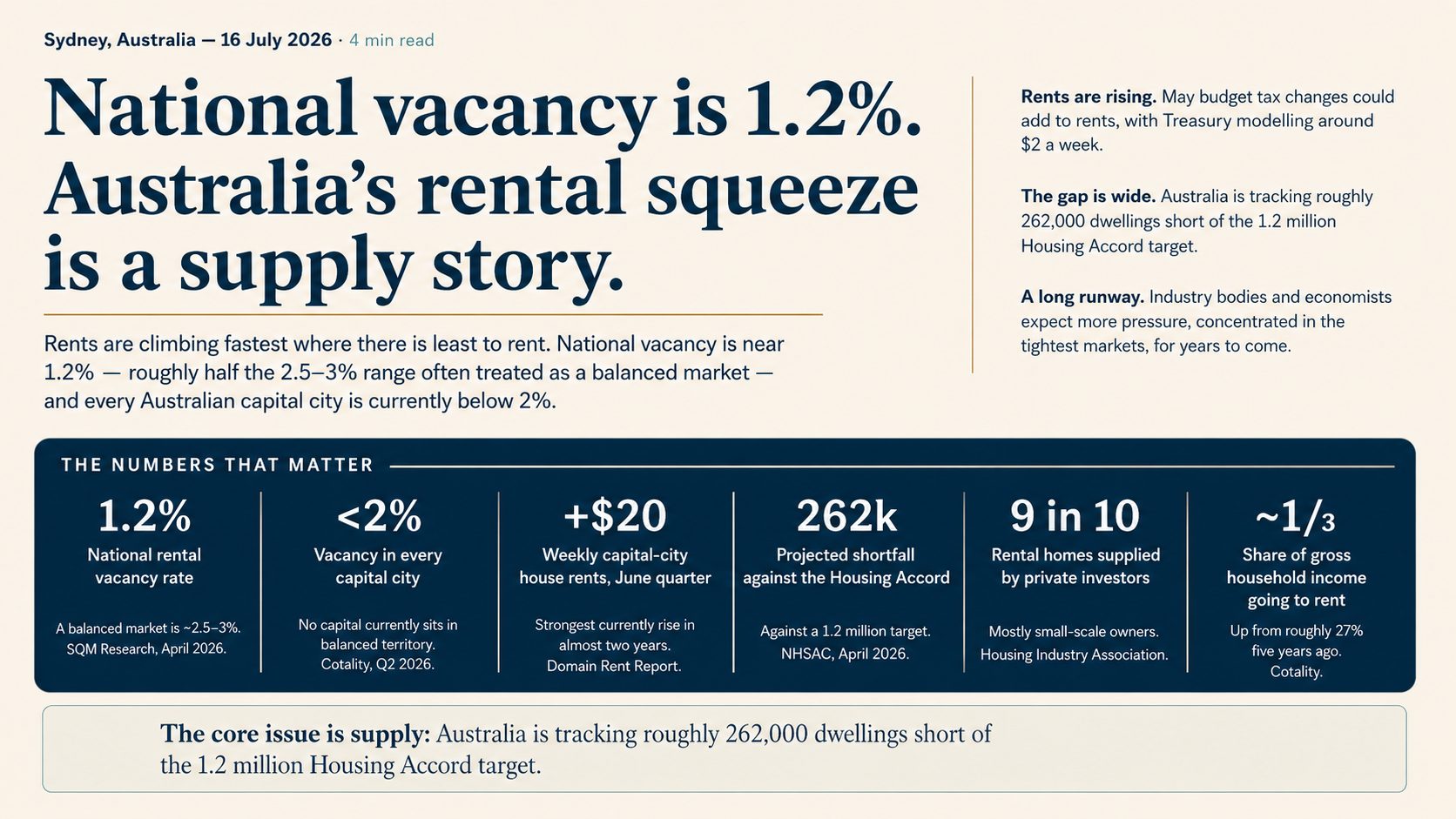

After a slowdown in early 2025, investors are returning to Western Australia’s regional property markets, attracted by high rental yields of around 9–11 percent in mining-linked towns such as Karratha, Port Hedland and Broome.
These areas offer strong rental demand because many properties are leased to mining companies, government departments, and associated contractors, providing stable tenancy and consistent income streams.
One major driver of this shift is that Perth’s property market has become overheated, with prices rising faster than rents, which has reduced rental yields. Investors are therefore increasingly looking toward regional centres where stronger cashflow opportunities exist.
However, conditions vary significantly across regional WA depending on employment drivers, housing supply, and population growth.

Investors in Kalgoorlie-Boulder are facing strong competition from first home buyers and downsizers. (Image source: Taras Vyshnya/Shutterstock.com)
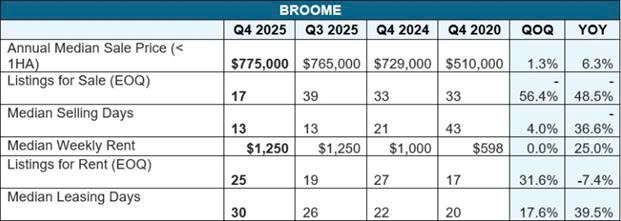
Broome Market Data
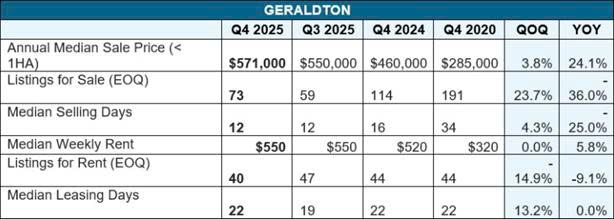
Geraldton Market Data
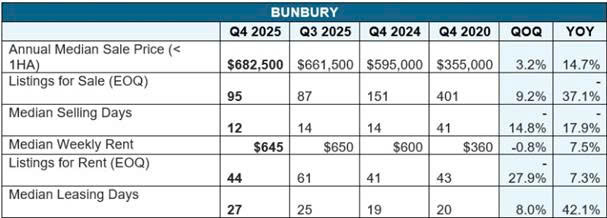
Bunbury Market Data
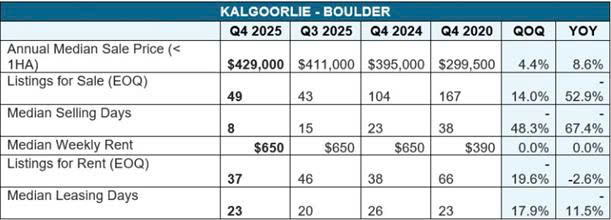
Kalgoorlie-Boulder Market Data
Implications for AusMod20K and Aura Modular
The return of investors to regional Western Australia highlights a structural housing shortage in mining and regional economies.
High rental yields indicate strong demand, but supply constraints remain severe in many regional centres. Traditional construction methods struggle to respond quickly due to labour shortages, logistics challenges, and long construction timelines.
The AusMod20K program aims to address these issues by accelerating housing delivery through industrialised modular construction.
Aura Modular homes can provide:
– Turnkey houses compliant with the National Construction Code
– Rapid installation compared with traditional construction
– Scalable housing supply for mining workforce accommodation
– Cost control through factory manufacturing
This model is particularly suitable for regions such as Port Hedland, Karratha, and other Pilbara towns where housing demand is driven by the resources sector and population mobility.
Implications for Port Hedland and the Pilbara Region
Port Hedland and the broader Pilbara region represent one of the most strategic locations in Australia’s regional housing market.
The article highlights that investors are returning to mining-linked towns due to strong rental yields that can reach 9–11 percent.
Port Hedland has historically been one of the strongest rental markets in the country due to the presence of major mining and logistics operations.
Key drivers of housing demand in Port Hedland include:
- workforce accommodation for mining companies and contractors
• population growth linked to the resources sector
• limited housing supply and slow delivery of new homes
• high construction costs and labour shortages in remote areas
These structural conditions make Port Hedland particularly suitable for modular housing solutions.
Projects such as Skippers Loop demonstrate how modular construction can accelerate housing delivery in the Pilbara. By manufacturing housing modules in controlled factory environments and transporting them to site, developers can significantly reduce construction timelines compared with traditional on‑site building.
For initiatives such as AusMod20K and Aura Modular, the Pilbara region offers a strong opportunity to demonstrate the benefits of modular housing:
- faster delivery of quality homes for workforce and residents
• reduced dependence on scarce regional construction labour
• better cost control in remote locations
• scalable housing solutions aligned with regional economic growth
As investor interest returns to mining towns and rental yields remain strong, modular housing developments in Port Hedland could play a critical role in increasing housing supply while supporting the long‑term growth of the Pilbara economy.
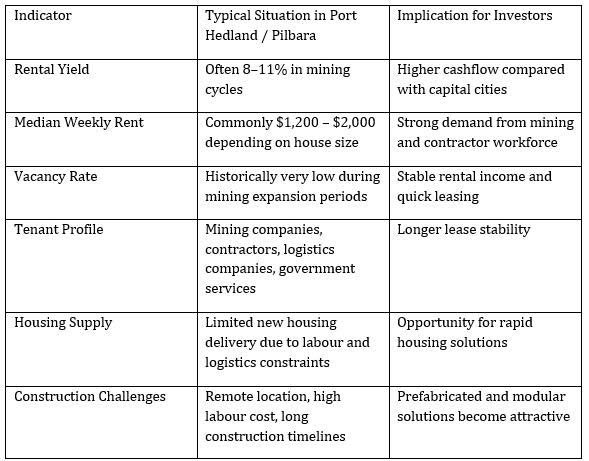
Port Hedland Investment Snapshot
Why Modular Housing Works in the Pilbara
Traditional Construction Challenges in Remote Mining Regions
↓
Labour shortages + High transport cost + Long construction timelines
↓
Housing supply cannot keep up with workforce demand
↓
Rental prices rise and housing shortages persist
Modular / Off‑site Construction Solution
Factory manufacturing → Quality control → Rapid installation on site
↓
Reduced labour requirement in remote areas
↓
Faster delivery of housing supply
↓
More stable rental market and support for regional economic growth
Why AusMod20K Aligns with WA Regional Housing Policy
Western Australia’s regional development strategy increasingly recognises the need for faster housing delivery in resource regions.
Mining towns such as Port Hedland, Karratha, and other Pilbara centres frequently experience housing shortages that affect workforce mobility and regional economic growth.
The AusMod20K initiative aligns with these policy priorities by enabling large‑scale housing delivery using industrialised construction methods.
Key policy alignment includes:
- Accelerating housing supply in regional and resource‑driven economies
• Supporting workforce accommodation in mining regions
• Reducing construction pressure on local labour markets
• Enabling scalable housing delivery through modern methods of construction (MMC)
• Supporting regional population growth and economic resilience
By combining modular construction capability with coordinated supply chains, AusMod20K and Aura Modular can help deliver housing at the speed required for regional Western Australia’s evolving economic landscape.
Financial Comparison: Traditional Construction vs Modular Construction
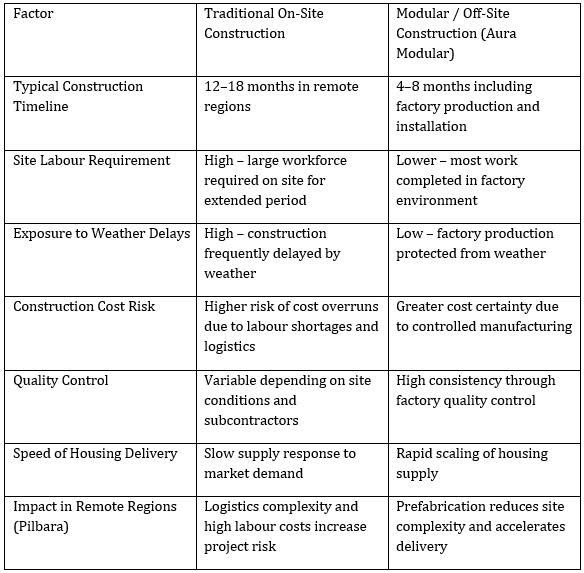
Overall, modular construction enables developers and governments to deliver housing more quickly in remote regions such as the Pilbara. By shifting a large portion of construction activity to controlled factory environments, project timelines can be shortened significantly while improving cost predictability and quality outcomes.
Why Port Hedland Can Become Australia’s First Modular Housing Acceleration Zone
Port Hedland presents a unique opportunity to become Australia’s first large‑scale modular housing acceleration zone.
Several structural factors make the Pilbara region particularly suitable for modular construction deployment at scale.
- Persistent Housing Shortage
Port Hedland and surrounding Pilbara towns regularly face housing shortages driven by mining expansion cycles.
Traditional construction cannot respond quickly enough to rising demand. - High Construction Costs in Remote Areas
Building in the Pilbara involves high labour mobilisation costs, accommodation costs for workers, and long logistics chains.
Modular construction reduces these pressures by shifting a large portion of construction activity into controlled factory environments. - Strong Rental Demand from the Resources Sector
Mining companies, contractors, and logistics providers require continuous workforce accommodation.
This creates strong demand for quality housing that can be delivered rapidly. - Government and Industry Alignment
Regional development strategies increasingly recognise the need for faster housing delivery in resource regions. Modular construction provides a practical pathway to accelerate housing supply without relying solely on scarce regional labour. - Demonstration Opportunity for Industrialised Construction
A coordinated program combining AusMod20K, Aura Modular, and regional development partners could demonstrate how industrialised housing systems can deliver homes faster, more efficiently, and at scale in remote Australian markets.
By positioning Port Hedland as a modular housing acceleration zone, stakeholders can:
- rapidly increase housing supply for the Pilbara workforce
• reduce pressure on regional housing markets
• create a repeatable model for other resource regions in Australia
• support long‑term economic growth and population stability in Western Australia’s resource corridor
Port Hedland Modular Housing Pilot – Proposed 50 / 200 / 1000 Home Rollout Scenario
The following staged rollout scenario illustrates how modular construction could be deployed in Port Hedland to progressively increase housing supply while demonstrating the efficiency of industrialised construction systems.
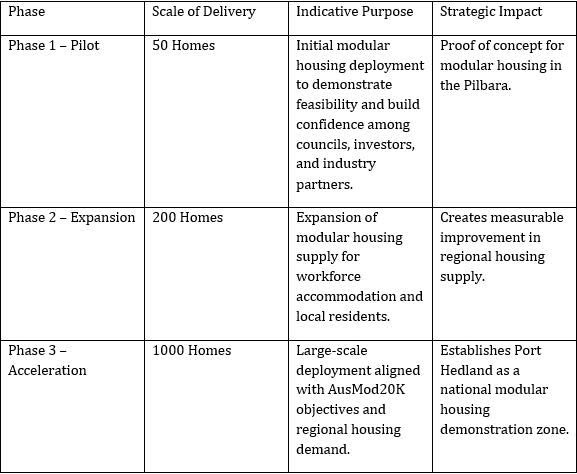
A staged rollout approach allows government, investors, and industry partners to progressively validate the economic and operational advantages of modular housing. Early pilot projects reduce risk, while larger phases unlock economies of scale and accelerate housing delivery across the Pilbara.
Estimated Economic Impact of 1000 Modular Homes in Pilbara
The deployment of 1000 modular homes in the Pilbara region would generate significant economic, housing, and workforce benefits. The following estimates illustrate the potential impact of a large-scale modular housing rollout aligned with the AusMod20K initiative.
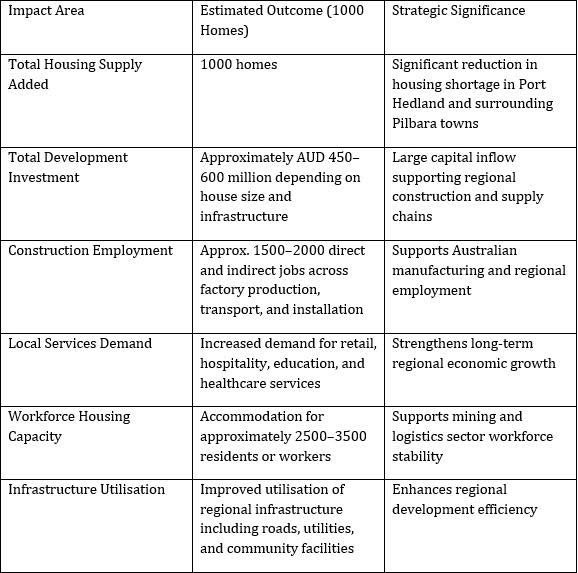
A modular housing program of this scale would not only address housing shortages but also stimulate economic activity across manufacturing, logistics, construction, and regional services. By combining industrialised construction with coordinated supply chains, AusMod20K and Aura Modular can deliver housing at scale while supporting long‑term economic resilience in the Pilbara.
If you would like to
Become a partner of the AUSMOD20K program, please click this link: Partner
Become a supplier for the AUSMOD20K program, please click this link: Supplier
See detailed information at: NEWS