
Australia’s Industrial Property Boom: Surging Demand, Shrinking Supply, and a Strategic Window for Investors
Australia’s industrial property sector is entering a powerful growth cycle, driven by rising demand, limited supply, and escalating construction costs. According to West bridge Funds Management, these structural factors are positioning industrial real estate in Australia as one of the most attractive asset classes for long-term investors.
Industrial Property Australia: Demand Surges as Supply Tightens
Australia’s growing trade relationships within the Asia-Pacific region, combined with a $22.7 billion federal investment into advanced manufacturing, are accelerating demand for logistics and warehouse infrastructure.
According to CBRE, vacancy rates across major industrial markets are currently sitting at just 3.2%, reflecting an extremely tight supply environment. At the same time, Colliers reports that 75% of new industrial developments completed in Q4 2025 were already pre-leased before completion, highlighting the intensity of tenant demand.
E-commerce Growth Driving Industrial Real Estate Demand
E-commerce continues to be a key driver.
For every $1 billion increase in online retail sales, Australia requires an additional 300,000–350,000 sqm of warehouse space.
With e-commerce penetration still below the US and UK, long-term growth potential remains significant.
Logistics and Trade Fueling Long-Term Growth
Logistics demand is also accelerating alongside trade growth.
Colliers estimates that for every 1,000 shipping containers processed through Australian ports, between 8,000–13,000 sqm of industrial space is needed. This strong correlation between trade volume and warehouse demand is reinforcing the sector’s long-term growth outlook.
Why Industrial Real Estate Is Attracting Investors
For investors, industrial real estate Australia offers a fundamentally different value proposition compared to residential property.
Industrial assets typically deliver:
- Longer lease terms
- Higher and more stable yields
- Demand driven by economic fundamentals rather than market sentiment
These characteristics make industrial property an increasingly attractive diversification strategy for investors who have traditionally focused on residential assets.
Rising Construction Costs Strengthen Existing Assets
Rising construction costs are pushing investors toward existing assets.
Properties with underutilization, below-market rents, or repositioning potential are increasingly attractive, offering faster returns and lower development risk.
Where the Smart Money Is Moving
While institutional capital dominates large assets, the $10M–$40M segment presents lower competition and strong value-add opportunities—especially for investors accessing via managed funds.
Key Considerations When Investing in Industrial Property Australia
To succeed in industrial real estate, investors need a strategic approach.
Key factors to evaluate include:
- Lease profile and tenant quality
- Rental positioning versus market rates
- True yield versus underlying asset risk
- Replacement cost and asset location
Importantly, higher yields should be carefully assessed, as they may reflect hidden risks such as shorter lease terms, deferred maintenance, or weaker locations.
Industrial Property Australia: A Structural Growth Story
Australia’s industrial property sector is being driven by long-term structural forces—e-commerce expansion, global trade flows, and government-backed manufacturing investment.
With supply constrained, demand accelerating, and costs rising, industrial real estate in Australia is no longer optional—it is becoming essential for forward-looking investors.
Industrial Property Australia: A Structural Growth Story
Driven by e-commerce, trade, and manufacturing investment, Australia’s industrial property sector is supported by strong long-term fundamentals. With supply constrained and demand accelerating, industrial real estate in Australia is becoming a core strategic asset.
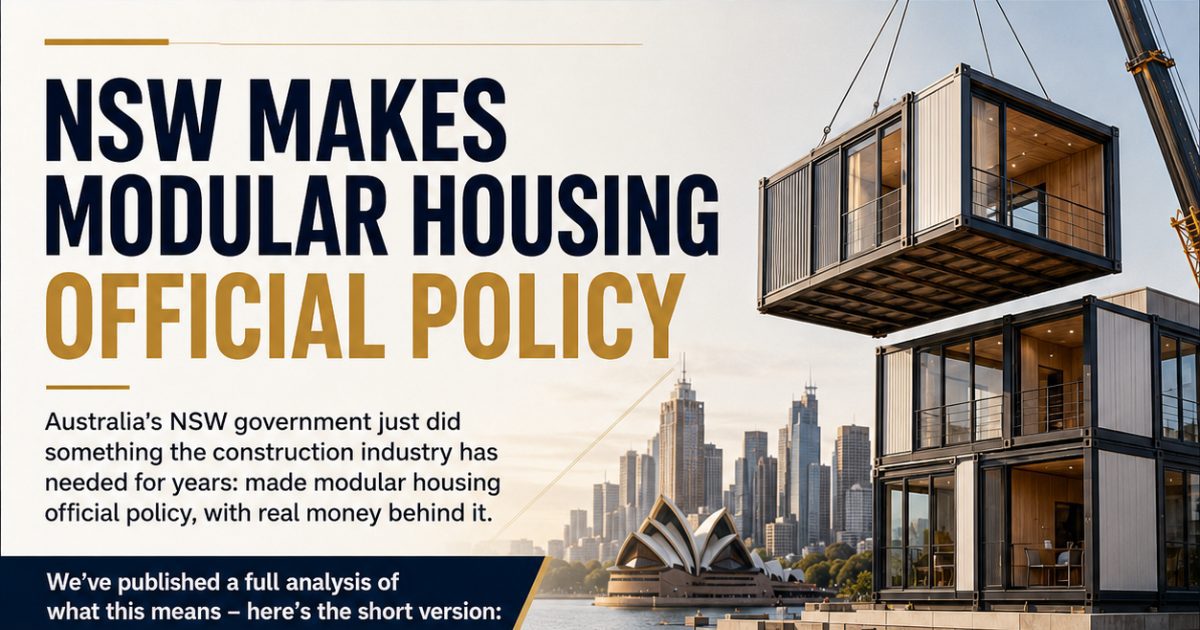
In this context, large-scale initiatives such as AusMod20K are emerging as practical responses to both supply constraints and rising construction costs. As a program focused on delivering 20,000 modular homes across Australia, AusMod20K leverages industrialised construction methods, streamlined supply chains, and prefabrication to significantly reduce build time and improve scalability.
By aligning closely with the growth of industrial real estate—particularly in warehousing, logistics, and manufacturing facilities—the program reflects how industrial infrastructure is increasingly being integrated into housing delivery. This not only helps address Australia’s housing shortage more efficiently, but also reinforces the role of industrial property as a critical enabler of next-generation residential development.
If you would like to
Become a partner of the AUSMOD20K program, please click this link: Partner
Become a supplier for the AUSMOD20K program, please click this link: Supplier
See detailed information at: NEWS