Industry News · Modular Construction
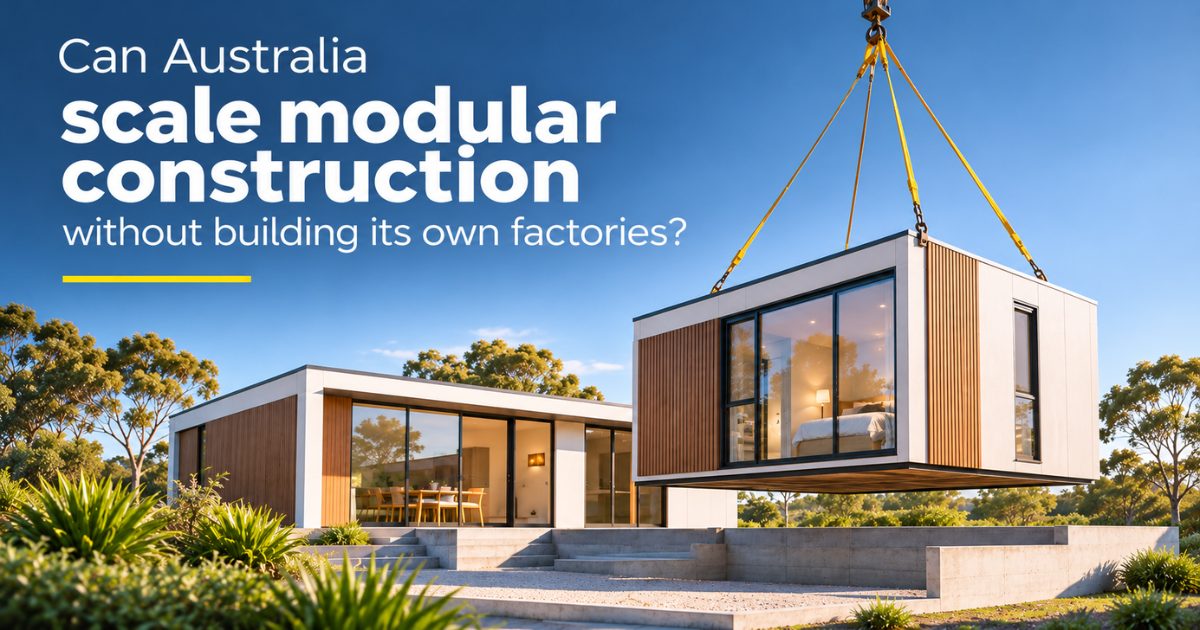
Can Australia scale modular construction without local manufacturing?
A University of Melbourne industry panel examined the tension between offshore modular supply, domestic manufacturing investment and the project pipelines needed to sustain local production.
Australia’s growing interest in modular construction is raising a question that goes beyond construction productivity. If more buildings are manufactured offsite, how much of that manufacturing should take place in Australia? A recent discussion at the University of Melbourne suggests the answer is far from settled.
The discussion followed a workshop titled Scaling MMC in Australia, held on 16 October 2026 at Melbourne Connect. The industry panel was chaired by Professor Christhina Candido of the University of Melbourne. Panellists included Filomena Beshara, Development Manager at Freecity Group; Fraser Paxton, Research Development and Education Manager at Building 4.0; Professor Priyan Mendis of the University of Melbourne’s Infrastructure Engineering discipline; and Associate Professor Patrick Fong of Griffith University’s School of Engineering and Built Environment.
Efficiency versus domestic capability
The panel examined the commercial priorities of developers, offshore suppliers and Australian manufacturers. Freecity’s approach draws on established international manufacturing capacity to deliver fully fitted modules, with design coordination, compliance, logistics and installation managed as one integrated process. The model offers a route to faster construction and reduced exposure to onsite labour constraints, but it also raises questions about how Australia’s domestic modular industry will grow.
A pointed contribution came from the audience. James Briggs, Founder and Managing Director of Shepparton-based JMB Modular Buildings, questioned the implications of relying more heavily on overseas manufacturing while Australian modular businesses continue to struggle to secure consistent demand.
Why local manufacturers find it hard to compete
Establishing a modular production facility requires substantial investment in equipment, skilled labour, engineering, quality systems and factory infrastructure. Unlike onsite construction, where labour can be adjusted to match workload, a factory carries significant fixed costs. Without a reasonably predictable production pipeline, manufacturers face difficult decisions about capacity, staffing and capital investment.
This creates a structural tension. Developers may be drawn to overseas manufacturers with established facilities, larger volumes and competitive pricing, while local manufacturers find it difficult to reach the scale needed to compete on similar terms.
Is the door open?
Responding to the audience, Ms Beshara said the company’s approach did not exclude Australian manufacturers. “The door is not closed whatsoever,” she said. The exchange highlighted a distinction between choosing an established international supplier for a particular development and adopting a permanent position against domestic manufacturing.
The exchange also showed the commercial conditions under which Australian manufacturers could participate. Developers assess suppliers on manufacturing capacity, cost, quality assurance, environmental outcomes (including the use of green steel), delivery reliability and the ability to meet programme. Domestic manufacturers must invest to demonstrate these capabilities, yet that investment is hard to justify without a credible pipeline of projects. Breaking that cycle, where manufacturers need committed demand and developers need confidence in capacity, remains one of the sector’s central challenges.
Risk moves rather than disappears
Another theme was how risk is allocated in modular projects. Manufacturing substantial parts of a building offsite changes the sequence of design, procurement, approvals and construction. Decisions that were once resolved during onsite work often need to be finalised before production begins. This brings greater certainty in some respects, but it can also concentrate commercial and technical exposure earlier in a project.
The point is particularly relevant to international supply, where design coordination, Australian regulatory compliance, factory inspection, shipping, customs clearance, transport and installation must be managed across different jurisdictions. The consequences of incomplete design information or late changes can be more serious when production is already underway overseas. The same principles apply to Australian manufacturers: industrialised construction demands earlier decisions, more complete documentation and closer coordination than many conventional procurement arrangements provide.
Manufacturing strategy or procurement strategy?
The workshop raised a broader policy question. Australia’s construction sector is under pressure to increase housing supply, lift productivity and shorten delivery times, and greater use of modern methods of construction is increasingly part of that response. However, the panel noted that increasing the number of prefabricated buildings delivered in Australia is not the same as developing an Australian prefabricated building industry.
The distinction matters for employment, skills, engineering capability, supply chain investment and long-term sector resilience. International manufacturers can provide capacity and expertise that may not yet exist locally at the required scale. At the same time, a procurement model driven mainly by the immediate cost and availability of offshore production may do little to address the barriers facing local manufacturers.
The policy challenge, as discussed, is to encourage more efficient construction without overlooking domestic manufacturing capability. That may involve more predictable procurement programmes, clearer regulatory pathways, better integration of manufacturing into project planning and greater certainty about future demand.
Why this matters for Australian modular housing
The question of where modular buildings are made is central to the supply chain behind affordable housing. AusMod20K focuses on modular housing, prefabrication and the Australian supply chain, and the panel’s concerns about pipeline certainty and domestic capability are directly relevant to that work.
To learn more about the modular housing supply chain and how Australian suppliers can engage with it, visit ausmod20k.com.au.
Explore AusMod20KAbout Pistis Group
Pistis Group is an Australia–Vietnam enterprise working across construction, building materials, real estate, international trade and business partnerships. Learn more at www.pistis.au.