Industry News · Prefabrication
What will it take to build prefab homes at scale?
A pilot has shown factory-built homes can be assembled quickly in Australia. Scaling them will depend on demand, finance and approvals, not certification alone.
Prefabricated housing in Australia has moved past the proof-of-concept stage, but The Good Builder argues that the harder question is how to build it at scale. The publication’s analysis draws on a recent pilot by Metricon, along with national and international data, to examine what the sector still needs.
What the pilot showed
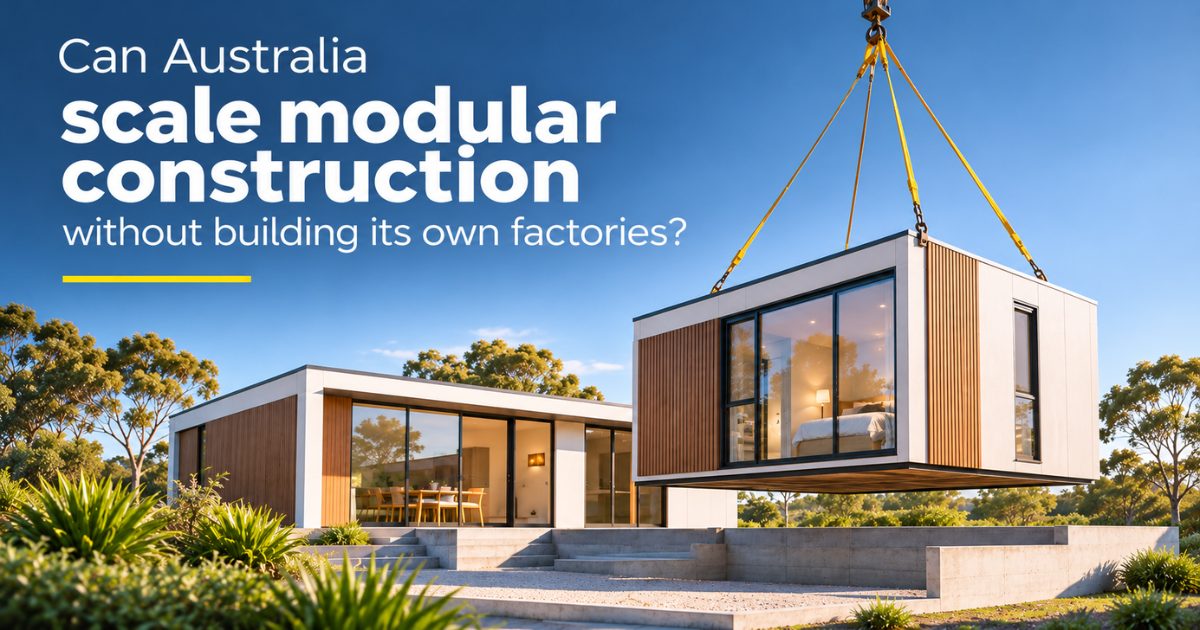
Metricon built two homes in 20 working days in July at Stockland’s Mt Atkinson Estate in Truganina, Melbourne’s west. Around 90 per cent of each home was made as factory wall panels and then assembled on a conventional slab. This is panelised construction, which differs from volumetric construction, where complete three-dimensional modules are built in the factory and craned into place.
The pilot proved that the assembly process works. It did not prove that the model can be repeated across thousands of homes a year.
The barriers to scale
Demand
According to the article, the Australian Building Codes Board (ABCB) identifies a lack of demand as one of the largest barriers. Steady orders are needed before manufacturers can justify investing in capacity. The article also cites a UK House of Lords inquiry into manufacturers that went into administration or halted production.
Finance
Construction finance is designed around site inspection stages, which does not fit factory production, where more money is spent upfront. The article reports that the Commonwealth Bank changed its approach in January 2025 and now lends against the build contract during offsite construction, subject to limits, although land remains the only security until the home reaches site.
Approvals and certification
The ABCB has proposed a national voluntary certification scheme for prefabricated manufacturers. Rather than inspecting each unit, the scheme would certify manufacturers’ systems, including quality management, traceability and workforce competency. The article notes that mandatory inspection stages would only change after legislative reform, and that the indicative start date is mid-2028.
The article quotes a single line that captures its position: certification “is one link in a chain, not the chain.” Certification addresses approvals, but on the ABCB’s own modelling, it does not address demand, finance, insurance, procurement or supply chain issues.
Government and international context
The article points to government activity. Queensland’s QBuild factory in Cairns has completed 30 modular homes since 2024, and Victoria reports more than 70 modular social homes delivered regionally with more under construction. New South Wales has passed legislation that recognises prefabricated buildings, although supporting regulations are still being developed.
Internationally, the article reports that prefabricated buildings make up about 95 per cent of new multi-dwelling buildings in Sweden and about 26 per cent of new single and duplex houses in Germany. In Australia, the ABCB estimates that prefabrication accounts for less than 8 per cent of total construction.
Why this matters for modular housing supply
Scaling prefabricated housing depends on the same things AusMod20K is working on: a dependable pipeline of projects, manufacturers ready to invest, and a supply chain that can deliver consistent quality. The article’s focus on demand and certification is directly relevant to that work.
To learn more about the modular housing supply chain, visit ausmod20k.com.au.
Explore AusMod20KAbout Pistis Group
Pistis Group is an Australia–Vietnam enterprise working across construction, building materials, real estate, international trade and business partnerships. Learn more at www.pistis.au.